
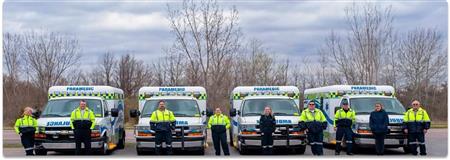
Rotarian Melanie Cressman introduced today's guest speaker, Chief Carl Bowker of Hastings-Quinte Paramedic Services. Chief Bowker started by providing a little history on ambulance services in the province of Ontario. Prior to 2000, ambulance services were the responsibility of the province. In 2000, that responsibility was downloaded to municipal government on a 50-50 cost sharing agreement. Hastings-Quinte Emergency Medical Services was formed in 2003 and serves the 14 member municipalities of Hastings County and the cities of Belleville and Quinte West. The name was changed to Hastings-Quinte Paramedic Services in 2013, to more accurately reflect how the profession has evolved. A department with the County of Hastings that operates within the second largest County in Ontario with a distance of 160 km from the Bay of Quinte to Algonquin Park. There are approximately 220 full and part-time staff, a fleet of 38 vehicles which includes 22 ambulances. There are stations in Picton, Belleville, Quinte West, Stirling, Madoc, Tweed, Tyendinaga and Bancoft. They respond to over 30,000 911 calls per year and are the second largest ambulance service in eastern Ontario, next to Ottawa.
There are two levels of care in land ambulance services -- Primary Care Paramedics and Advanced Care Paramedics. All paramedics in Ontario are certified to perform delegated medical acts under the license of a physician. All paramedics in eastern Ontario are certified under the Regional Paramedic Program of Eastern Ontario (RPPEO). During the pandemic in 2000, Hastings and Prince Edward emerged relatively unscathed from the first wave compared to urban centres. Staffing levels were sustained and ambulance call volume decreased as people feared going to the hospital. The service has grown from 84 full-time paramedics to over 140 full-time post pandemic as paramedic services evolved to meet pre-hospital care needs of communities during and after the pandemic. 40% of all frontline staff have been hired in the last 3 years.
Chief Bowker touched on some of the paramedic programs in effect in addition to 911 calls. These challenges or opportunities came about during and after the pandemic due to limited access to family doctors, homecare services, elective surgeries. Public Health became overwhelmed with the demand for vaccines and needs support. Seniors at home are in need of more care. Community Paramedicine is an emerging model of healthcare in which paramedics apply their skillset in a non-traditinal community-based environment. In Hastings County, Community Paramedic home visit programs were established in 2015 and have evolved into a multi-disciplinary approach.
- Seniors Home Visit -- targets seniors on the long-term care waitlist. Funded by the Ministry of Long-Term Care
- Community Outreach -- focused on homeless and addictions, community paramedics work with mental health and addictions councillors. Funded by the Ministry of Health
- Remote Monitoring -- eligible clients are provided with equipment that measures their blood pressure, oxygen saturation and blood glucose levels Alerts are sent to community paramedics if the results are outside normal values.
- CP@Clinic -- paramedics lead clinics in social housing or retirement homes. Evidence based approach that counsels patients on how to manage their health more effectively
- LTC Diagnostics -- provide point-of-care testing, ultrasound, urinalysis in long-term care homes that would otherwise necessitate a hospital visit
- Palliative Care -- supporting medical assistance in dying program
Thanked by Rotarian, Dr. Ruth Mathieson for a very comprehensive presentation. Reassuring for the services provided.